
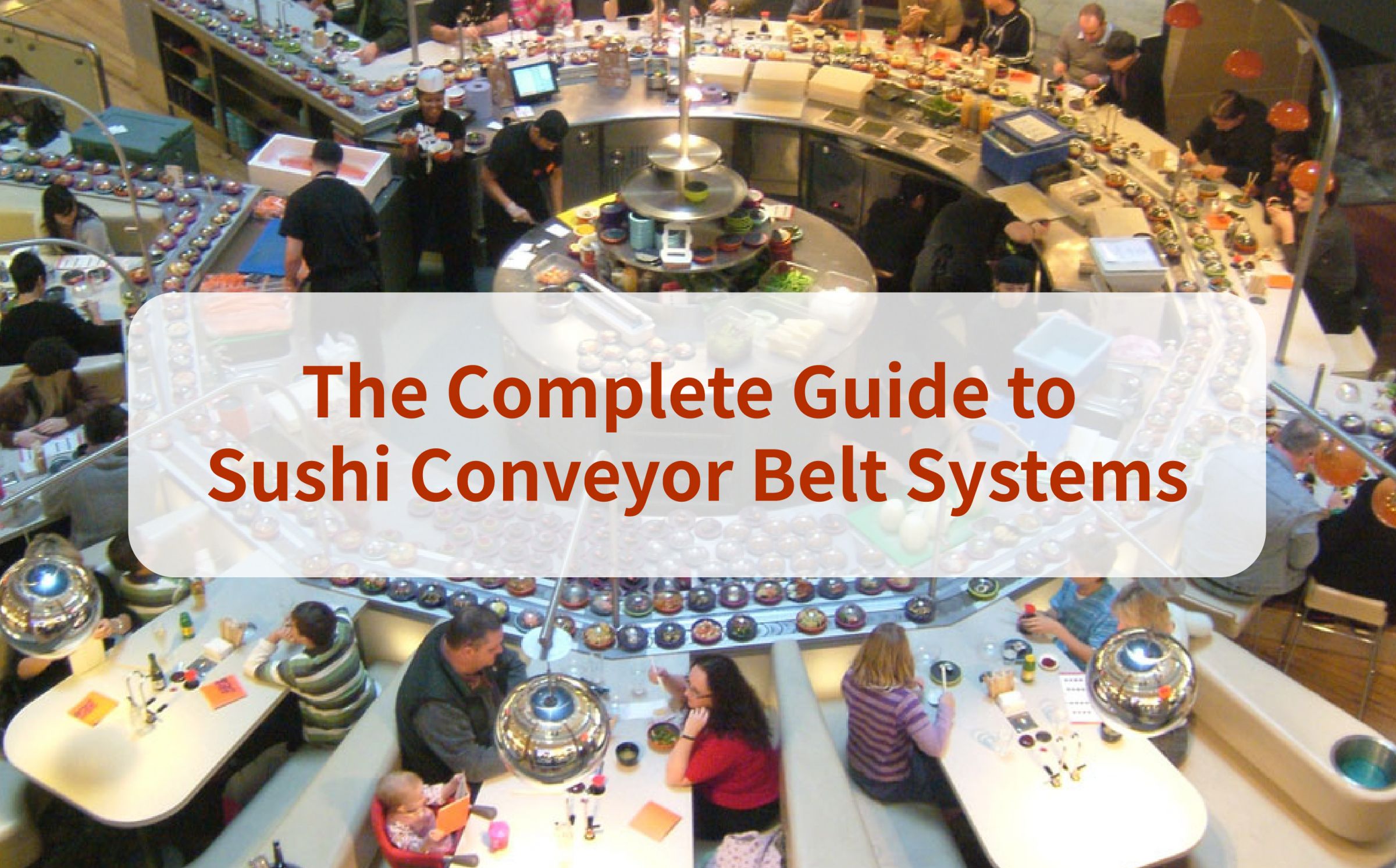
Sushi conveyor belt systems — also known as revolving sushi — have long moved beyond being just a novelty dining experience. Today, a well-planned sushi conveyor belt system functions as a complete "restaurant operating system." It integrates the customer dining experience, kitchen production pacing, labor optimization, and data-driven compliance management into a highly scalable infrastructure. For modern restaurant operators and investors in North America and Europe, the conveyor belt is no longer just a decorative centerpiece. It has transformed into a strategic "automation platform" capable of significantly reducing Front-of-House (FOH) labor requirements, ensuring stable operational throughput during peak hours, and generating a quantifiable return on investment.
1. Market Size & Global Growth Trends
The US sushi restaurant industry generates over $30 billion in annual revenue, and the growth of the conveyor belt sushi market has emerged as one of the strongest segments driven by automation. Operators are increasingly gravitating toward automated sushi concepts because, in a highly volatile labor market, they offer advantages that traditional full-service restaurants struggle to achieve: predictable output throughput, stable staffing ratios, and consistent unit economics.
↳ Understanding this market shift is just the first step. To truly grasp this trend and secure profitability, investors must change the timeline of when they think about "automation." It shouldn't start with the menu; it should begin before the lease is even signed.
2. Pre-Opening Strategy: Planning Completed Before Signing the Lease
Before brand design, interior decor, or menu engineering takes place, high-performing projects treat the conveyor system as the restaurant's foundational infrastructure, rather than a mere equipment add-on. Savvy operators answer three critical questions early on:
- Will the sushi conveyor system delay the construction schedule? (Only if the initial blueprint fails to incorporate routing and foundation engineering plans.)
- Can the system's investment payback period realistically be achieved in 18–36 months? (Yes, through permanent reductions in labor costs and faster table turnover.)
- Will restaurant automation degrade the service experience? (No, it simply shifts the employee's role from a "food runner" to a "hospitality guide.")
↳ Once these strategic questions are answered and the lease is secured, the focus must immediately shift from "theory" to the "blueprint." How do you truly integrate this system into the physical and digital space?
3. Core Engineering Decisions & Ecosystem Integration
Every successful conveyor sushi system design starts with physical engineering decisions that dictate long-term efficiency:
- Circulation Engineering: The spatial layout must strictly separate customer flow from Back-of-House (BOH) restocking routes to prevent congestion and collisions.
- Production Pacing: The kitchen's production speed must perfectly match the conveyor belt's speed; otherwise, plates will pile up, disrupting the dining rhythm.
Tech StackAPI & POS/KDS System Integration
However, the physical layout is only half the battle. A conveyor belt cannot exist as an "information silo." Modern, high-end systems feature open API architectures that allow for direct synchronization with mainstream cloud POS systems (like Toast) and Kitchen Display Systems (KDS).
- When a customer orders via tablet, the KDS immediately dispatches the order to the prep station. The system then routes the dish to the bullet train (express lane), delivering it directly to the table while automatically updating the POS ledger—ensuring 100% billing accuracy.
Beyond Efficiency: The Financial Logic of Hybrid Automation
Why do top restaurant groups invest so heavily in this seamless integration of physical and digital engineering? Because this level of integration fundamentally rewrites the restaurant's financial equation. In today's fiercely competitive market, top operators no longer view automation as a "single expense item," but as a cornerstone strategy to ensure Return on Investment (ROI) and operational resilience.
1. Structural Shift in Labor Costs
The restaurant industry's labor shortage has evolved into a persistent structural challenge, with labor costs typically eating up 30% to 40% of total revenue. Hong Chiang's data-driven integration examples demonstrate that deploying smart conveyor belts and automated delivery systems can permanently reduce Front-of-House (FOH) daily labor overhead by an average of 53%. By automating high-frequency, low-skill physical transportation tasks, operators drastically reduce their reliance on specific labor availability on the floor. This allows employees to transition from exhausted "plate carriers" to "hospitality guides," focusing their energy on high-margin upselling and customer satisfaction rather than wasting it on logistical labor.
2. Maximizing Space & Asset Utilization (RevPASH Optimization)
The efficiency of automation comes down to how much value you can squeeze out of every square foot. In our real-world application cases, automated delivery systems demonstrated a 206% increase in delivery throughput compared to traditional manual service. This surge in mechanical efficiency directly translates to higher table turnover rates (RevPASH). By decoupling kitchen output from the availability of FOH food runners, restaurants can maximize total capacity during critical peak revenue hours—essentially serving more covers per shift without needing to expand the physical footprint or create complex scheduling matrixes.
3. Building Operational Resilience Through Data-Driven Decisions
The true power of integrating POS, KDS, and automated hardware lies in data transparency. When every plate of food can be tracked via an integrated API, decision-making transitions from "gut feeling" to actionable intelligence. This operational visibility provides two clear financial safeguards:
- Predictive Flow Management: The automated system dynamically analyzes real-time dining volume to optimize delivery routing, clearing capacity bottlenecks before they even form.
- Preventive Maintenance: Integrated diagnostic arrays provide predictive health monitoring, identifying mechanical wear and tear before a "Friday Night Disaster" occurs—effectively eliminating the risk of costly emergency downtime during prime operating hours.
4. The Core of ROI: Payback Period & Unit Economics
While the upfront Capital Expenditure (CapEx) for a conveyor system is substantial, the unit economics it unlocks completely justify the investment.
- Labor Efficiency: A well-executed model can compress labor cost percentages from 35% down to ~20–25%, significantly reducing the need for FOH floor staff.
- Higher Ticket Sizes: The continuous movement and visual abundance of the conveyor belt trigger impulse purchases from customers, typically lifting average check sizes by 10–15%.
↳ While CFOs focus on these stunning ROI metrics, Operations Directors know that financial success is ultimately driven by the "human" element: customer experience and employee trainability.
5. Experience Design & Operational "De-skilling"
Modern consumers increasingly value dining autonomy and pacing. They want to start eating faster and avoid time-consuming waits. Low-pressure dining automation naturally aligns with this shift, creating a participatory experience where the customer feels in control.
Scalability and the Power of "De-skilling"
This autonomy-driven model solves the biggest hurdle to corporate expansion: reliance on highly trained labor. Automated sushi systems introduce operational "De-skilling"—standardizing workflows so that operations rely on precise systems rather than scarce "star" employees.
- In leading automated chain restaurants in the US, the time required to train a new employee to full proficiency has been reduced by 40%. Employees simply follow screen prompts on the KDS (Kitchen Display System) and place plates on the designated tracks.
- This low-skill-barrier, standardized model makes aggressive expansion possible—allowing brands to grow from 5 pilot locations to over 50 branches in less than 5 years.
↳ After designing an operational model that is highly scalable, low-skill, and high-satisfaction, the challenge shifts to actual execution: How do we build this without causing costly construction delays?
6. Typical Project Workflow: Preventing Installation Delays
In commercial projects, every week of delay can mean tens of thousands of dollars in "dead rent" (paying rent before opening). Therefore, a structured installation workflow is non-negotiable:
- Phase 1 (Site Assessment): Evaluate electrical capacity and structural limitations as early as possible.
- Phase 2 (Pre-wiring): Embed the necessary dedicated circuits and data ports during the initial framing phase.
- Phase 3 (Modular Installation): Utilize prefabricated components to accelerate on-site assembly time.
- Phase 4 (Calibration & Testing): Conduct stress tests for stopping precision and RFID inventory accuracy prior to the soft opening.
↳ When operators execute these builds across diverse floor plans, many realize that a single traditional conveyor belt might not reach every corner of the restaurant. This brings us to today's most advanced operational models.
7. Hybrid Automation: The Triple-Path Delivery Ecosystem
Relying solely on a single delivery method introduces operational risk. Top operators deploy a Hybrid Automation Ecosystem—combining multiple delivery routes to strike the perfect balance between speed, visual merchandising (triggering impulse buys), and full-restaurant coverage.
System ArchitectureThe Triple-Path Model
- Traditional Conveyor Belt: Best suited for displaying high-turnover items that easily trigger impulse purchases; this is the core driver of visual sales.
- Bullet Train (Express Lane): High-speed linear tracks used to deliver made-to-order, customized premium dishes directly to the table.
- Autonomous Mobile Robots (AMRs): The ideal solution for private dining rooms, corners, or areas that physical tracks cannot reach due to structural limitations.
↳ However, as this ecosystem becomes more complex, the risk shifts as well. Total reliance on technology means any system failure could instantly paralyze operations. How do we protect it?
8. Risk Management & Operational Stability
Even the best systems face risks. The fundamental difference between a high-performing automated restaurant and a struggling one lies in operational resilience and the implementation of contingency plans.
The "Friday Night Disaster" and Localized Support
The true hidden cost of equipment is "downtime." A system failure at 7:00 PM on a packed Friday night can instantly wipe out an entire weekend's profits. When importing systems from overseas, relying entirely on international logistics for spare parts is a critical, devastating risk.
- Modular Architecture: The system must feature "plug-and-play" component designs. If a motor fails, FOH staff should be able to replace it themselves in minutes.
- Localized US/EU Support: Partnering with manufacturers who have regional maintenance and tech teams can turn a crisis that might close a restaurant for two weeks into a simple fix resolved in two hours.
↳ Mitigating these risks requires more than just local spare parts; it demands proactive management. To prevent disasters, operators must monitor the daily health of their systems.
9. Maintenance & KPIs: Financial Control Systems
Preventive maintenance is a financial strategy, not a technical afterthought. Smart operators use backend software to track specific KPIs and treat them as business levers:
- Weekly Downtime (Target: < 30 minutes)
- POS Checkout Error Rate (Target: < 5%)
- RFID Inventory Waste Rate (Target: < 15%)
When these metrics become transparent and actionable in real-time, automated operations become highly predictable, which directly translates into stable profitability.
↳ Ultimately, even the most profitable and well-maintained system is useless if it cannot pass the strict regulatory standards of local health and safety authorities.
10. Compliance & Regulations: UL, NSF, and CE Certifications
Food safety and electrical compliance must be engineered into the project from day one. Securing UL (Underwriters Laboratories) and NSF (National Sanitation Foundation) certifications are non-negotiable foundational business assets when scaling across American and European markets.
ComplianceWhy Inspectors Look for NSF & UL:
- NSF Standards: Ensures the conveyor belt utilizes non-porous, food-grade materials and eliminates "cleaning blind spots," allowing daily washdowns to highly prevent bacterial cross-contamination.
- UL Standards: Guarantees that electrical enclosures and emergency stop mechanisms meet rigorous fire safety standards. This is not only a hard requirement for municipal licensing inspectors but can also significantly lower the restaurant's insurance premiums.
Conclusion
Sushi conveyor belt systems have moved far past being just a dining novelty—they are now infrastructure platforms. By merging automation, data intelligence, hybrid fulfillment delivery, and experience design, these systems turn "motion" into measurable business value.
When implemented strategically—from pre-lease planning to meeting NSF compliance—automation reshapes the economics of the restaurant industry. It secures profit margins in a volatile labor market, delivers predictable ROI, and lays a highly scalable foundation for expansion across regional markets.