
📌 Key Summary
Restaurant labor discussions lately have centered on digitizing back-office procurement, but getting supplies in the door only solves the first half of the problem. A delivery robot typically carries roughly 2x the table capacity of a single server per trip, and the U.S. restaurant industry is still short more than 200,000 workers versus pre-pandemic staffing levels (National Restaurant Association, 2026), with projected industry sales reaching $1.55 trillion this year. Drawing on Hong Chiang Technology's 22 years in restaurant automation, this article explains how equipment multiplies the capacity of existing front-of-house staff rather than replacing them — freeing up time for tableside service and complaint handling, the things only a person can do. It includes a real before/after case from Skylark Group's all-you-can-eat hot pot concept Shabu Yeh, and a reference case from Din Tai Fung.
1. Two Battlegrounds: Supplies Get In the Door — Who Gets Them to the Table?
Recent restaurant labor discussions tend to focus on back-office procurement — ordering, reconciliation, supply chain management, moving from scattered manual workflows to digital integration. That's a real and previously overlooked drain on labor hours.
⚠️ The Battleground Procurement Digitization Doesn't Touch
Digitizing procurement solves getting supplies in the door. What happens after food reaches the kitchen — who delivers it to the customer, how fast — is a separate battleground that determines the guest experience just as directly: the front of house.
Both battlegrounds sit under the same larger problem: there simply isn't enough labor. The difference is where the fix applies. Back-office labor gets freed up by handing administrative work to a system. Front-of-house labor gets freed up by handing carrying and moving to equipment, so limited staff can go back to doing the things only a person can do.
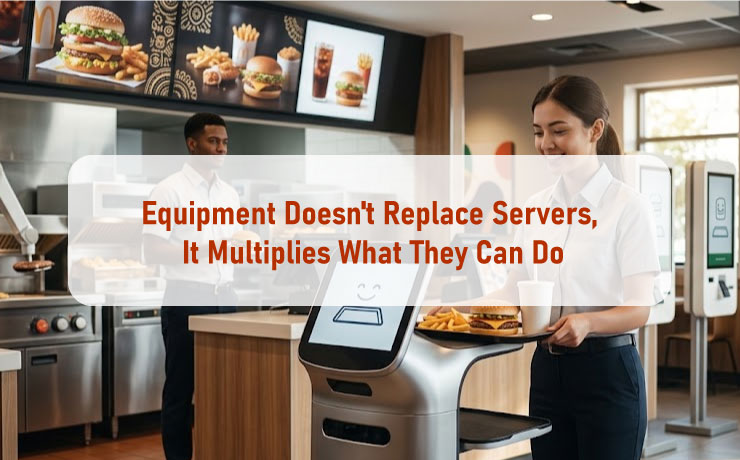
2. Equipment Doesn't Replace Servers, It Multiplies What They Can Do
The first hesitation most operators have about adopting equipment is: "If we hand off service to a machine, don't we lose control of the floor?" It's a reasonable concern, but the answer runs opposite to what most people assume.
Equipment doesn't decide how to serve a guest. It handles carrying, moving, and restocking — repetitive work that doesn't require judgment in the moment. What actually requires a person — tableside interaction, handling a complaint, noticing a guest needs a refill, adapting to something unexpected — equipment can't do, and shouldn't.
💡 Multiplying Capacity vs. Replacing Labor
Equipment doesn't multiply the number of machines in the building. It multiplies the service capacity every existing server-hour can produce. Headcount doesn't change, but how many tables each server can properly attend to — and the quality of that attention — does.
3. A Real Case: From Hauling Meat Plates to Tableside Service
Taiwan's leading delivery robot distributor, He-Yu Technology, shared a concrete example: Shabu Yeh, an all-you-can-eat hot pot concept under Skylark Group, found that before adopting delivery robots, servers spent nearly all their time carrying meat plates.
| Stage | What Servers Were Actually Doing |
|---|---|
| Before | Either carrying a plate of meat or on their way to carry one — with almost no bandwidth left to attend to anything else a guest needed |
| After | Robots took over carrying meat plates. Servers freed up time for tableside service, and both delivery speed and the dining experience improved |
Another frequently cited reference is Din Tai Fung, whose team spent a full three weeks on-site calibrating robot routing to make sure delivery speed and serving temperature were both preserved — a reminder that upfront floor-plan routing work matters if equipment is going to deliver a real capacity gain.
▲ Hong Chiang's delivery robot systems are deployed across 45+ countries and thousands of restaurant brands
4. Core Technology Behind Front-of-House Capacity
To free servers from carrying and hauling, Hong Chiang builds capacity into four categories of front-of-house equipment:
1. Rail-Guided Food Delivery Robot
Modular track design adapts to different floor plans, supports multi-cart concurrent operation, and takes delivery — a mechanical task — off servers' hands.
2. Express Delivery Lane
No need to throw extra staff at a peak-hour crunch to cover carrying — the equipment holds its own rhythm, freeing limited labor to focus on what guests actually need from a person.
3. Rotating Conveyor System
Hands continuous replenishment to the system's run logic, so servers aren't constantly running back and forth to the kitchen and can stay on the floor attending to guests.
4. AI Tablet Ordering System
Digitizes the back-and-forth of order-taking and paper tickets, so servers spend less time shuttling between the table and the kitchen.
5. The Best Division of Labor Between People and Equipment
In a labor-constrained environment, rethinking the front-of-house division of labor follows the same logic as back-office procurement: repetitive, mechanical work goes to equipment; work that needs in-the-moment judgment and human warmth stays with people.
| Task | Who Handles It | Why |
|---|---|---|
| Delivering food, carrying plates | Equipment | Highly repetitive, fixed routing — well suited to systemization |
| Continuous replenishment, conveyor restocking | Equipment | Pacing can be pre-set, no in-the-moment judgment needed |
| Order-taking and ticket routing | Equipment | Digitizing reduces back-and-forth trips and paper errors |
| Tableside interaction, refills | People | Requires reading the guest and responding in real time |
| Handling complaints and the unexpected | People | Requires judgment and adaptability |
| Describing dishes, shaping the guest experience | People | Requires warmth and brand personality |
Once equipment takes over the repetitive work, the server's role quietly gets upgraded — from someone who's constantly carrying things to someone who's actually serving the guest. It's the same logic as a procurement staffer moving from administrative processing to cost management after digitization — just playing out on the floor instead of in the back office.
6. Frequently Asked Questions
7. Conclusion: What Restaurants Gain When Capacity Gets Multiplied
In a labor-constrained environment, the people already on staff are the resource a restaurant has to work with. Equipment was never meant to solve "we can't find people" on its own — it's meant to make sure every person on the floor spends their time where they actually create value. Equipment doesn't multiply the number of machines; it multiplies the service capacity every server-hour can produce.
🚀 Take Action
Want to see how Hong Chiang's delivery robots and conveyor systems can help your restaurant multiply existing staff capacity in a tight labor market? Contact our team for a free site assessment and custom configuration plan.
→ Get the Full Equipment Catalog → View Case Studies
📚 Data Sources
- National Restaurant Association — 2026 State of the Restaurant Industry
- Cornell Center for Hospitality Research — Restaurant industry turnover analysis
- He-Yu Technology / BusinessNext (Taiwan) — Delivery robot industry reporting, including Shabu Yeh and Din Tai Fung cases