

2026 Restaurant Delivery Robot Comparison: Your Ultimate Buying Guide
Product Review: Food Delivery Robots. Helping Restaurant Owners Choose the Right Automation Solution.
Looking to upgrade your restaurant with automation in 2026? We've got you covered.
This guide provides a comprehensive look at the top food delivery robots and rail systems on the market. We break down popular models like Pudu Robotics' BellaBot, Bear Robotics' Servi, and Keenon Robotics' DinerBot.
We'll compare everything from how they navigate to their payload capacity, battery life, and pricing, so you can make the smartest choice for your business.
📌 Core Summary
In 2026, U.S. restaurant automation has moved from experiment to operating standard as labor shortages turn structural. This guide compares two ways to deliver food: autonomous mobile robots (AMRs) from Pudu, Bear Robotics and Keenon (BellaBot, KettyBot, PuduBot 2, FlashBot, HolaBot, SwiftBot, Servi, DinerBot), and Hong Chiang's rail delivery robots, built in Taiwan: the 3D Rail, Direct-Serve and Fresh-Cover models. Three questions decide the choice: how much aisle space the robot takes, whether it holds up at peak hours, and how it handles multiple floors. The global restaurant technology market is projected to reach $6.9 billion in 2026 [1]. Use this guide to match a solution to your format, traffic and payback window.
1. Three Strategic Benefits of Delivery Robots in Restaurants
For U.S. restaurants, staffing is no longer a temporary hurdle. By 2026 it has settled into a permanent labor crisis: more than 60% of operators still run below the staffing level they need, which means shorter hours and lost sales [2]. Wages keep climbing too. With state-level minimum-wage pushes reaching $17–$20/hr, labor now takes more than 34% of restaurant revenue and squeezes margins hard [3]. Turnover adds to the bill. Replacing one front-of-house employee costs an average of $2,300 in recruiting and training, and multi-unit operators feel that directly in EBITDA. In that environment, a delivery robot is less a tech upgrade than a financial tool for steadying operations and protecting margin.
Here are the three core benefits:
Addressing Labor Shortages and Optimizing Workforce Allocation

Restaurants face labor shortages, rising costs, and growing efficiency demands.
Autonomous mobile robots (AMRs) reliably handle repetitive tasks like food delivery, reducing reliance on entry-level staff. Studies show robots can cut long-term labor costs by up to 40%, since they need no salary, benefits or insurance. Meanwhile, staff can focus on high-value guest interactions: recommending popular dishes, sharing the brand story, giving personal service. That lifts table turnover and guest satisfaction, especially at peak hours.
Creating Safe and Innovative Dining Experiences

Creating safe and innovative tech-driven dining experiences
Since the pandemic, demand for contactless service has stayed high, and AMRs reduce person-to-person contact. The technology also draws younger guests, who like to share the experience on social media, which gives the restaurant extra brand exposure and a modern, tech-forward image.
Data-Driven Management and Scalable Expansion

Leveraging data to manage restaurants and plan expansion
AMRs log delivery times and routes, which helps you tune kitchen workflow and service. For restaurant chains, that data is the basis for standardized operations and store replication.
In short, delivery robots do more than save money. They ease labor pressure, speed up service, improve the guest experience and give you data for growth. Before you invest in an AMR, though, look at the pros and cons below.
2. Pros and Cons of Autonomous Mobile Robots (AMRs)
AMRs are driving restaurant digitization, but you should weigh benefits against challenges before adopting one. Here is a closer look.
Advantages of AMRs
- Efficiency and Productivity Boost: Robots handle repetitive tasks like food delivery and table clearing quickly and accurately, with no breaks. During peak hours they cut wait times and speed up table turns, which lifts revenue directly.
- Long-Term Cost Savings: With labor shortages worsening, a robot needs no salary, overtime or benefits. Over time that cuts costs significantly, especially where hiring is hard.
- Accuracy and Safety: Precise navigation and task management mean few misdelivered orders. Contactless delivery also reduces transmission risk.
- Customer Appeal: Interactive designs (such as expressive displays) attract families and younger guests and give the brand something to talk about.
Challenges of AMRs
- High Initial Investment: The AMRs compared here run roughly $8,000–$25,000 per unit. That is a real burden for small and mid-size restaurants, and payback timelines vary.
- Environmental Limitations: AMRs still struggle in crowded aisles or when obstacles appear suddenly. Multiple floors require an elevator plus elevator-control integration (FlashBot offers both cloud and hardware options). In outdoor or very busy areas, navigation accuracy can drop.
- Lack of Human Touch: An AMR can't give a warm greeting, a personal recommendation or handle a guest problem the way staff can. Over-reliance can make the experience feel impersonal.
- Maintenance and Downtime Risks: Robots need regular software updates, hardware maintenance and battery management. A failure interrupts service and requires technical support, which costs money and disrupts operations.
- Limited Applicability: AMRs are less effective in upscale restaurants, artisanal Japanese venues or sprawling layouts where human service is the point. They fit standardized, high-traffic formats like hot pot or fast casual better.
AMRs deliver long-term efficiency and cost savings, but the challenges call for careful planning. Success depends on three things: a clear business need (do you actually need one?), a sober ROI analysis (when do you recoup the cost?), and a plan for how staff and robots work together.
For operators considering an AMR, this is more than an equipment purchase. It affects operations, brand image and long-term competitiveness.
3. AMRs vs. Rail Delivery Robots: Side-by-Side Comparison
The table below compares eight AMRs (Pudu, Bear, Keenon) with Hong Chiang's three rail delivery robots. AMR data comes from official manufacturer sites and market information; rail robot data comes from Hong Chiang's product pages. Prices vary by region and distributor, so contact us or a local agent for a current quote.
| Product Name | Appearance | Navigation & Positioning | Tray Layers & Payload | Battery & Endurance | Software & Interface | Additional Features & Design | After-Sales Support | Price (Estimated) |
|---|---|---|---|---|---|---|---|---|
| Autonomous Mobile Robots (AMRs) | ||||||||
| Pudu BellaBot |  Details |
LiDAR + Visual SLAM | 4 layers, 10 kg (22 lbs) per layer, total 40 kg (88 lbs) | 12-24 hours, 4.5-hour charge | Multi-language (English, Chinese, etc.), touchscreen | Cat-themed design, voice interaction, quick battery swap, 3D obstacle avoidance | Global | USD 20,000 – 15,000 |
| Pudu KettyBot |  Details |
Laser + Visual SLAM | 2-3 layers, 10 kg (22 lbs) per layer, total 30-40 kg (66-88 lbs) | 8-11 hours, 4-5-hour charge | Multi-language, ad display, voice interaction | Narrow-space design (55 cm / 21.7 in), 360° fisheye camera, tray detection | Global | USD 8,400 – 12,000 |
| Pudu PuduBot 2 |  Details |
Visual + Multi-Sensor Fusion | 3-7 layers, 10-13 kg (22-28 lbs) per layer, total 40-66 kg (88-145 lbs) | 10-15 hours, 4-6-hour charge | Multi-language, LED strip interface | Large trays (42x50 cm), adjustable trays, industrial-grade frame | Global | USD 12,000 – 8,000 |
| Pudu FlashBot | 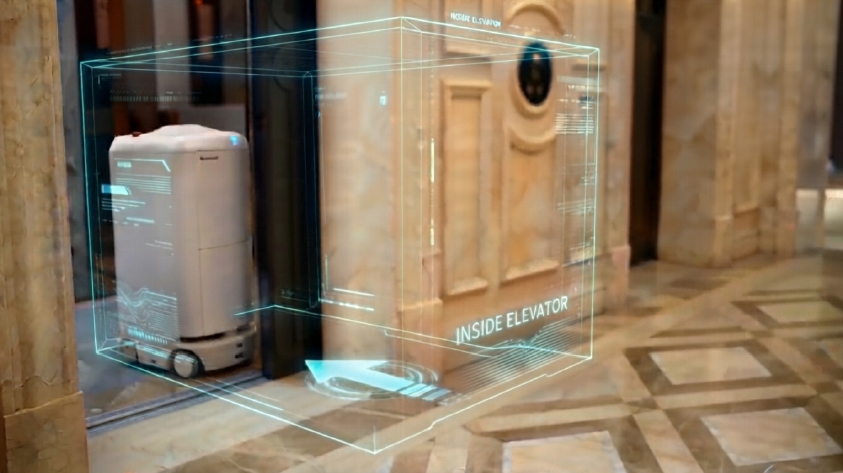 Details |
VSLAM+ and LiDAR SLAM, extends to semi-outdoor areas | 2-4 adjustable compartments, 10 kg (22 lbs) per layer | 9 hours, 4-hour charge | Cloud management platform, multi-robot scheduling, compartments unlock by passcode, phone number or NFC | Cloud and hardware elevator control (compatible with KONE, OTIS), 60 cm / 23.6 in aisle clearance, ventilated compartments, auto-charging | Global | USD 20,000 – 28,000 |
| Pudu HolaBot | 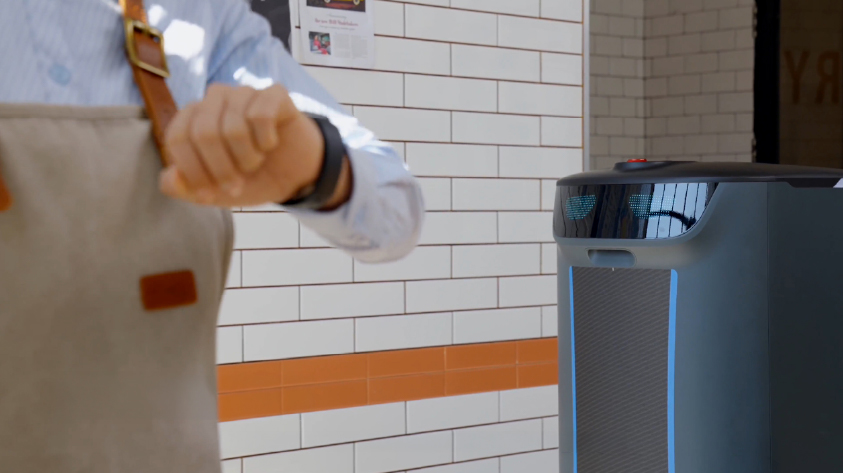 Details |
3D laser obstacle avoidance + depth sensing | 4 layers, up to 15 kg (33 lbs) per layer, total 60 kg (132 lbs) | 10-24 hours (swappable battery), 4.5-hour charge | Gesture recognition + voice control, cloud system integration | Watch, pager, tablet and sensor calling; IPX5 splash-resistant cabin | Global | USD 15,000 – 16,000 |
| Pudu SwiftBot | 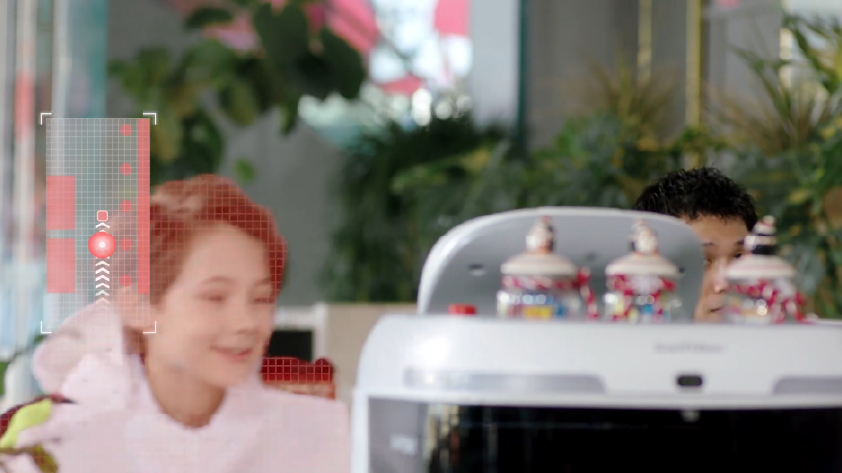 Details |
360° omnidirectional perception + active-avoidance algorithm | 3 trays standard, up to 5, total 35 kg (77 lbs) | 9 hours (no load), 4.5-hour charge | 4G / LoRa / Wi-Fi / Bluetooth / RFID, 6 service modes, one-tap calling | Automotive-grade suspension, smart protective door (enclosed or open style), foot-pedal door, 80 cm / 31.5 in minimum clearance; manufacturer data: about 50% less foot-traffic congestion | Global | USD 16,000 – 22,800 |
| Bear Servi |  Details |
Intelligent LiDAR | 3-4 layers, 10 kg (22 lbs) per layer, total 30-40 kg (66-88 lbs) | 10-12 hours, 4-6-hour charge | Multi-language (English primary), POS integration | Delivery function, auto-charging, narrow-space (65 cm / 25.6 in), NSF certified | Global | USD 12,000 – 14,000 |
| Keenon DinerBot (T9/T10) |  Details |
SLAM + Visual Detection | 4 layers, 10 kg (22 lbs) per layer, total 40 kg (88 lbs) | 8-15 hours, 4-5.5-hour charge | Multi-language, AI voice, remote control | Adjustable tray height, self-pickup design, tray detection | Global | T9/T9 Pro USD 9,800 – 12,000 T10 USD 10,000 – 16,400 |
| Hong Chiang Rail Delivery Robots (designed and built in Taiwan) | ||||||||
| 3D Rail Food Delivery Robot SkyRoute R Series |
 Details |
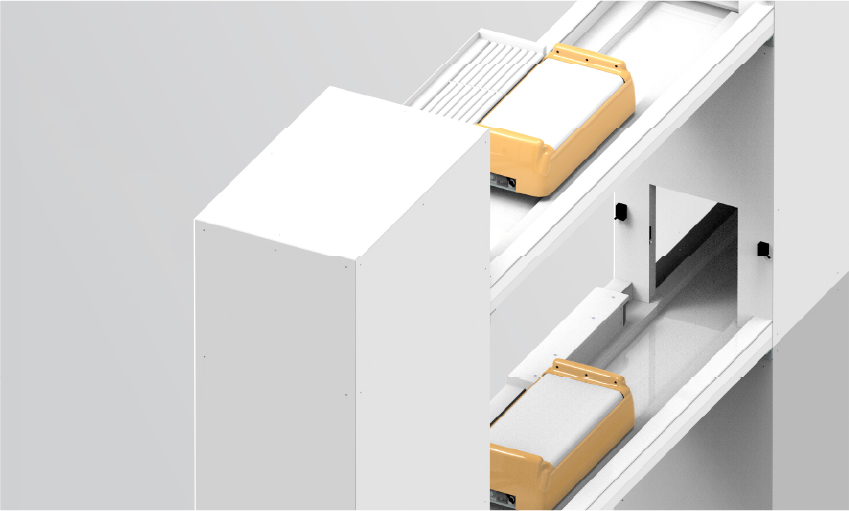
Ceiling / elevated fixed rail, vertical climb between floors; TOF distance control between carts | Customized to the menu; multiple carts run on one rail | Brush-contact power charges while running, 24-hour operation | Smart dispatch, one-way or two-way pickup; exterior and paint 100% customizable | Zero floor space, no dumbwaiter needed for multi-floor service. 57% less floor space than a traditional dumbwaiter, 80% faster installation. Manufacturer data: +206% delivery efficiency, −53% labor cost, +32% space utilization | Direct from Hong Chiang (Taiwan); shipped to 45+ countries | Customized quote (by track length and floors) |
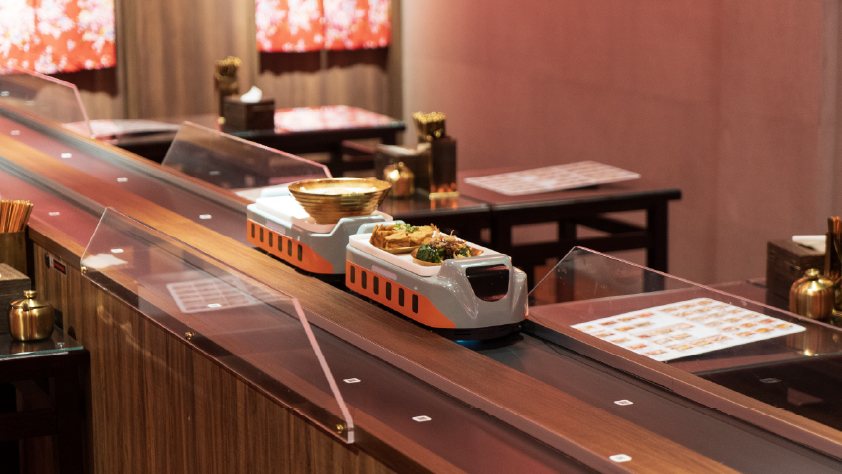
| Direct-Serve Smart Delivery Robot C / D / L Series |
 Details |
Fixed rail + smart positioning; AI traffic control prevents rear-end collisions, up to 100 carts on one track | 4-6 kg (9-13 lbs) per cart (C: 4 kg; D and L: 6 kg) | 24-35 hours continuous (C 24 h, D 30 h, L 35 h) | Data dashboard, scheduled dispatch; works with POS, KDS and ordering systems | Fixed rail, so foot traffic can't block it. Up to 1.3 m/s (78 m/min), open-top carts with no height limit, two-way pickup, narrowest rail in the industry. Manufacturer data: +200% delivery efficiency, −50% labor need | Direct from Hong Chiang (Taiwan); shipped to 45+ countries | Customized quote (by track length and cart count) |
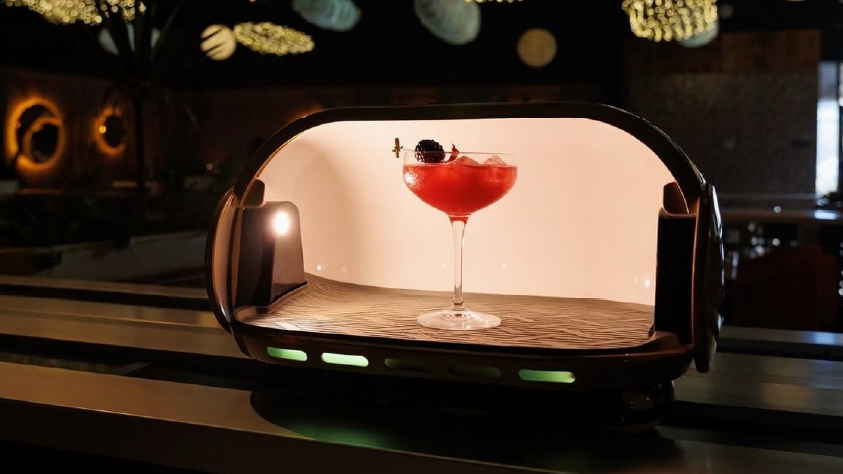
| Fresh-Cover Smart Delivery Robot P / Q Series |
 Details |
Fixed rail + smart positioning; TOF sensing brakes gradually for obstructions | 2-4 kg (4-9 lbs) per cart (P: 2 kg; Q: 4 kg) | 14 hours continuous | Data dashboard, scheduled dispatch, POS / KDS integration; multiple pickup stations, remote live diagnostics | Fully automatic protective lid, no spilled soup. Lid tested over 1 million open/close cycles, S-curve motion control, cart never extends past the rail, up to 1.3 m/s. Manufacturer data: paired carts raise delivery efficiency by more than 200% | Direct from Hong Chiang (Taiwan); shipped to 45+ countries | Customized quote (by track length and cart count) |
Note: Prices are estimates and subject to currency fluctuations, taxes and distributor terms. FlashBot and SwiftBot are quoted on request. Rail delivery robot pricing is customized by restaurant size, track length and number of carts. AMR prices in this table range from about USD 8,000 to 25,000. Rail payload is per cart; total throughput comes from many carts running on one track and delivering point to point.
What Each Rail Robot Does, and How It Beats an AMR
The table gives the numbers. Here is what each of the three rail robots is built for, and where it has the advantage over an AMR.
3D Rail Food Delivery Robot (SkyRoute R Series)
Delivery moves to the ceiling, so the whole floor stays with your guests.
Ceiling / elevated rail | vertical climb between floors | brush-contact power, 24-hour operation | one-way or two-way pickup | exterior and paint 100% customizable
Features
- A vertical lift module replaces the traditional dumbwaiter: 57% less floor space, 80% faster installation, no wall demolition or large shaft.
- Modular, building-block rail routes around columns, beams and walkways, so awkward spaces can still carry track.
- TOF distance sensing controls spacing in real time, so carts can follow closely and use the rail fully.
- Brush-contact power charges the carts while they run, with no downtime for charging.
- Manufacturer data: +206% delivery efficiency, −53% labor cost, +32% space utilization.
Advantages over an AMR
- An AMR drives on the floor and competes with guests and servers for the aisle. The 3D Rail robot runs overhead, so a crowded aisle never slows delivery.
- An AMR needs an elevator to change floors (FlashBot does this), which means waiting for the car and sharing it with other riders. The 3D Rail robot has its own vertical lift and never uses the building elevator.
- AMRs run 8-24 hours before they need a recharge or a battery swap. The 3D Rail robot charges while it runs and operates 24 hours a day.
Direct-Serve Smart Delivery Robot (C / D / L Series)
Dishes go from the pass straight to the right table, with no loop past every seat and no waiting.
Fixed rail + smart positioning | up to 1.3 m/s (78 m/min) | 4-6 kg per cart | 24-35 hours continuous | two-way pickup
Features
- Open-top carts have no height limit, so any plate size fits.
- Narrowest rail in the industry (manufacturer claim), with a circular-track option that frees floor area. Manufacturer data shows table capacity can more than double.
- AI traffic control senses the gap between carts and prevents rear-end collisions, so up to 100 carts share a track without jams.
- Scheduled dispatch and a data dashboard, plus compatibility with common ordering, KDS and POS systems, so you keep your current workflow.
- Manufacturer data: +200% delivery efficiency, −50% labor need.
Advantages over an AMR
- Several AMRs (BellaBot and SwiftBot, for example) cruise at about 0.5-1.2 m/s and slow, yield or wait when people are in the way. Direct-Serve stays on its own rail at up to 1.3 m/s and nobody can block it.
- An AMR needs an aisle at least 20.5-31.5 in (52-80 cm) wide (KettyBot 52 cm, FlashBot 60 cm, Servi 65 cm, SwiftBot 80 cm). Direct-Serve uses the narrowest rail in the industry and leaves the floor to guests.
- AMRs typically carry several tables' orders and wait at each stop for guests to pick up. Direct-Serve delivers point to point, one order to one table, the moment the dish is ready.
Fresh-Cover Smart Delivery Robot (P / Q Series)
A fully automatic lid keeps soups and hot dishes as the kitchen plated them.
Fixed rail + smart positioning | up to 1.3 m/s | 2-4 kg per cart | 14 hours continuous | fully automatic protective lid
Features
- The lid follows the rail's curve and has been tested over 1 million open/close cycles. It retracts inward, so it never swings out into the aisle.
- S-curve acceleration and braking keep a full bowl of soup from spilling at speed. TOF sensing slows the cart gradually when something is on the rail, with no hard stop.
- The cart never extends past the rail, so guests on the far side are not disturbed.
- Supports multiple pickup stations and queued carts waiting at the kitchen, and remote live diagnostics if a fault occurs on site.
- Manufacturer data: paired carts raise delivery efficiency by more than 200%. Patented lid design (Taiwan invention patent I723923).
Advantages over an AMR
- Most AMR trays are open (a few models have doors). Fresh-Cover is covered the whole way, which limits cooling, drying and dust.
- An AMR rolls across the floor and relies on suspension and floor flatness to limit sway (SwiftBot cites +20% stability). Fresh-Cover combines a fixed rail with S-curve control, so motion is smooth and predictable.
- An AMR detours and stops in a crowd, so travel time varies. Fresh-Cover's path is fixed, so time from the pass to the table is predictable.
4. Which Delivery Solution Suits Your Restaurant?
Ideal for: Family-friendly restaurants, kid-oriented venues or themed dining (hot pot, cafes), where the playful design boosts engagement with younger guests. It costs more, but it excels in casual dining.

Cat-shaped design and voice interaction engage customers
Ideal for: Small restaurants, bars or fast-food outlets (street food, coffee chains). The compact design and extra functions suit budget-conscious operators.

Ad screen ideal for in-store promotions
Ideal for: Large buffets, banquet halls or hospital catering, where high-volume peak-hour delivery matters. Pricing is budget-friendly.

Multiple trays and durable frame, budget-friendly (Source: Pudu)
Ideal for: Hotel room service, apartment package delivery and office buildings. It is designed to bring things upstairs, not to keep up with a restaurant's peak-hour tickets. For multi-floor food service, see the 3D Rail robot below.
Rides elevators and unlocks compartments by passcode or NFC, built for hotels and residential buildings
Ideal for: Refilling and bussing in large restaurants, hospital and clinic delivery, and internal deliveries inside a company.
60 kg payload, remote calling by watch or pager
Ideal for: Hot pot chains, buffets, banquet halls and food halls. It still uses floor space, though, and needs 31.5 in (80 cm) of clearance, so it is not a fit for aisles narrower than that.
Yields to guests and staff, built for high-traffic venues
Ideal for: Busy mid-sized restaurants, hotels or fast-food chains (American diners, buffets). Leasing options lower the entry barrier for operators who want to try one first.

Integrates delivery and POS with stable navigation (Source: Bear Robotics)
Ideal for: Diverse restaurants (hotel room service, barbecue venues). The flexible trays fit different dishes, and the pricing suits mid-to-large chains.

Flexible trays suit various dishes at reasonable prices (Source: Keenon)
Ideal for: Space-constrained or multi-floor restaurants, awkward layouts, operators who want to replace a dumbwaiter, and restaurants that want the equipment itself to be a photo opportunity (exterior and paint are 100% customizable).
Overhead and multi-floor, a replacement for the traditional dumbwaiter
Ideal for: High-volume dine-in restaurants such as sushi, barbecue, rice bowl and set-meal concepts that want faster service without adding headcount.
Straight from the pass to the table at up to 1.3 m/s
Ideal for: Hot pot, Western, rice bowl and barbecue concepts, and any menu heavy on soups and hot dishes where hygiene and plating matter.
A fully automatic lid keeps soups and hot dishes looking right at the table
5. Why Rail Delivery Robots Are the Stronger Choice
AMRs work well in flexible layouts, and that's not in dispute. But a restaurant's delivery problems usually sit elsewhere: tight aisles, peak-hour jams, spilled soup, a robot that stops working. Hong Chiang's 3D Rail, Direct-Serve and Fresh-Cover rail delivery robots solve those problems structurally, not with software workarounds. Here is how they compare with AMRs on six points:
- Space and Path Optimization
- AMR Limitations: AMRs need wide aisles. The ones compared here need 20.5-31.5 in (52-80 cm), and at peak hours a guest or server in the way stops them. Even SwiftBot, tuned for congestion (about 50% less, per manufacturer data), still shares the floor with people. Changing floors takes an elevator: FlashBot can ride one on its own, but it waits for the car and shares it with other riders. In the U.S., aisle width is also a code question (accessible routes, fire egress), so a robot that uses floor space competes with more than guests and servers.
- Rail delivery robots: They never compete for aisle space. Compared with a standard layout, they can at least double the available seating. The 3D Rail robot moves delivery overhead and connects floors with a vertical lift module that uses 57% less floor space than a traditional dumbwaiter and installs 80% faster, making full use of your vertical space.
- Delivery Efficiency and Precision
- AMR Limitations: Speed and route change with the environment, and stopping to avoid an obstacle stretches delivery times. In a busy restaurant, staff may have to guide the robot or step in.
- Rail delivery robots: The path is fixed. Direct-Serve and Fresh-Cover run at up to 1.3 m/s, AI traffic control prevents rear-end collisions, and up to 100 carts can share a track without jams. Docking is precise, so every dish stops in the same place. Manufacturer data: Direct-Serve +200% delivery efficiency and −50% labor need; 3D Rail +206% delivery efficiency. That predictability is ideal for all restaurant types, especially those with strict speed requirements.
- Stability and Safety
- AMR Limitations: Uneven floors, low traction or a sudden collision can tip or spill a dish. Obstacle avoidance helps, but accidents still happen. SwiftBot's automotive-grade suspension raises stability by about 20%, which reduces sway but doesn't eliminate it.
- Rail delivery robots: Food rides smoothly the whole way. Fresh-Cover uses S-curve motion control, so a full bowl of soup doesn't spill even at speed, and TOF sensing slows the cart gradually when something is on the rail. The cart and its lid never extend past the rail, so they can't hit guests or servers.
- Customization and Versatility
- AMR Limitations: Mostly standardized products, with fixed payload and tray designs that are hard to adapt to specialty dishes.
- Rail delivery robots: Each of the three has its own strength: 3D Rail for multi-floor service, Direct-Serve's open-top cart for dishes of any height, Fresh-Cover for soups and hot food. Exterior and paint are 100% customizable, and the systems fit sushi, hot pot, barbecue, rice bowl and Western concepts alike. Track systems can also be extended to bussing and supply transport.
- A fair note: Rail carts hold 2-6 kg (4-13 lbs) each and are built for one order to one table, the moment it's ready. For moving a lot of dishware or restocking in bulk (banquet bussing, for example), a high-payload AMR like PuduBot 2 or HolaBot is the better tool, and the two can work together.
- Cost and Planning
- AMR Limitations: At roughly $8,000-$25,000 per unit, the payoff depends heavily on your floor plan. Narrow paths, slopes or uneven floors make robots stop often and sometimes need a human to clear the way. Adding more robots doesn't fix that, and breakdowns can even add work for staff.
- Rail delivery robots: Hong Chiang offers 100% customized solutions. We use simulations to design the seating and delivery paths that maximize revenue, so you can estimate daily earnings before you open. Pricing depends on restaurant size and delivery needs, and we provide free design and planning. From a small noodle shop to a large chain, we tailor the system so every dollar is well spent.
- Maintenance and Reliability
- AMR Limitations: Complex sensors and navigation software raise the odds of a failure. Downtime interrupts delivery, and waiting for the manufacturer's technician costs efficiency and revenue.
- Rail delivery robots: A mature mechanical structure and a fixed path give them far lower failure rates than AMRs. Modular design keeps most maintenance simple, and the Fresh-Cover model reports equipment health around the clock, so Hong Chiang can spot a fault and fix most software issues remotely. If a cart does stall, swap it off the track and service resumes, which keeps repair cost and operating risk to a minimum.
Conclusion: Rail delivery robots address the AMR pain points of crowded aisles, delivery speed and stability. They fit every restaurant layout and dining type, and especially space-constrained, high-traffic or multi-floor venues.

Rail delivery robots are the stronger choice for restaurant automation
6. Five Key Considerations for Choosing a Delivery Solution
Choosing between an AMR and a rail delivery robot comes down to your layout, budget and brand. These are the deciding factors:
- Space and Environmental Fit: Measure your aisles first. Minimum AMR clearance: KettyBot 20.5-21.7 in (52-55 cm), FlashBot 23.6 in (60 cm), Servi 25.6 in (65 cm), SwiftBot 31.5 in (80 cm). If your aisles are under 31 in (80 cm), choose rail. For multi-floor restaurants, choose the 3D Rail robot. Aisles are also accessible routes and fire egress in the U.S., so check with your local building department before adding anything that uses floor space.
- Payload and Functionality: Match the robot to how you serve. One order to one table, fast and steady: Direct-Serve. A menu heavy on soups and hot food: Fresh-Cover. Moving a lot of dishware or restocking in bulk: PuduBot 2 or HolaBot. Lighter menus or guest interaction: BellaBot or Servi.
- Budget and Support: AMRs carry a high per-unit cost, while rail systems are customized to your size and priced competitively. Prioritize Hong Chiang, a restaurant automation brand that supports customers from Taiwan to 45+ countries, and ask about dealer, installation and service coverage in your state. Leasing options like Servi's lower the barrier if you want to trial one first.
- Customer Experience and Brand Fit: BellaBot's playful design attracts younger guests. Rail robots can be customized 100% in look and paint, which adds a high-tech feel to busy venues and gives guests something to post about.
- Future Scalability and Power: Look for multi-language support, OTA updates and POS integration. Direct-Serve and Fresh-Cover work with common ordering, KDS and POS systems, and the modular rail design supports long-term upgrades. The listed power input for the rail systems is 100-240 V, 50/60 Hz, which covers standard U.S. supply. Confirm your site's electrical details with us.
Practical Advice: Arrange an on-site trial to test performance. Contact Hong Chiang for a free layout design and revenue simulation so you can see the real costs and benefits. Contact us to arrange your free layout.
7. Frequently Asked Questions
What is the difference between a rail delivery robot and an AMR?
An AMR navigates the floor on its own, so its route can change. It suits wide aisles and layouts that get rearranged. A rail delivery robot runs on a fixed rail, takes no aisle space, arrives on a predictable schedule and carries food smoothly. Restaurants with aisles under 31 inches (80 cm), heavy peak traffic, multiple floors or a lot of soup and hot dishes are usually better served by rail.
How do I choose between the 3D Rail, Direct-Serve and Fresh-Cover models?
Choose the 3D Rail Food Delivery Robot if you need to move between floors, want to replace a dumbwaiter, or cannot spare any floor space. Choose the Direct-Serve robot for high-volume dine-in service where dishes go straight from the pass to a specific table. Choose the Fresh-Cover robot when soups and hot dishes dominate the menu and hygiene and presentation matter. Hong Chiang draws a free layout to confirm the fit.
For multi-floor delivery, should I choose FlashBot or the 3D Rail robot?
FlashBot rides elevators between floors, which suits hotel rooms, apartment package delivery and office buildings. Restaurant service is time-sensitive, and the 3D Rail robot has its own vertical lift, so it never waits for an elevator. It takes 57% less floor space than a traditional dumbwaiter and, per manufacturer data, raises delivery efficiency by 206%.
How much does a rail delivery robot cost compared with an AMR?
Rail systems are quoted per project, based on restaurant size, track length, floors and number of carts. Hong Chiang provides free layout design and a revenue simulation. The AMRs compared in this guide run roughly $8,000 to $25,000 per unit.
Do Hong Chiang rail robots work in U.S. restaurants?
Hong Chiang builds its rail systems in Taiwan and has shipped to more than 45 countries. The listed power input is 100-240 V, 50/60 Hz, which covers standard U.S. supply. Contact Hong Chiang for layout, dealer and installation details for your state.
8. Conclusion: Strategic Investment for Long-Term Success
AMRs and rail delivery robots are two routes to restaurant digitization, and both address labor shortages, efficiency and brand image. Pudu, Bear and Keenon AMRs offer flexible routing and strong guest interaction, which suits restaurants with wide aisles and layouts that change. Hong Chiang's 3D Rail, Direct-Serve and Fresh-Cover rail delivery robots offer a fixed path, stability and zero aisle use, which suits restaurants with narrow aisles, heavy peak traffic, soup-heavy menus or more than one floor. Measure your aisles, work out your peak order volume, then pair a trial with expert advice to pick the right system and turn the equipment into a long-term profit asset.
🔎 Not Sure Which Model Fits? Filter by Scenario
Hong Chiang's commercial service robots page helps you find the right robot for your use case. Start with what's slowing your operation down, then filter by Core Needs and Use Case (multi-select). Turn on Multi-Floor / Elevator Integration to see only models that ride elevators or cross floors on their own.
Aisle width, multiple floors, soup or packages: tick the boxes and the list narrows. It covers 11 delivery and guest-service models plus 6 heavy-duty transport and sorting robots.
→ Open the Robot Selector🚀 Take Action Now
Want to know how Hong Chiang can lower labor costs and lift table turns in your restaurant? Contact our consultants for a Free Layout Design.
→ Consult Hong Chiang
📚 Data Sources
- Business Research Insights — Global Restaurant Technology Market Size & Growth Trends (2026–2035)
- National Restaurant Association (NRA) — 2026 State of the Restaurant Industry Report.
- Bureau of Labor Statistics (BLS) — Wage and Labor Costs in the Hospitality Sector 2026.
- Office of the United States Trade Representative (USTR) — Section 301 Tariff Exclusions and Taiwan Trade Advantage Updates.
- Forbes — How AI and Robotics are Transforming the ROI of Modern Dining
Read More: Automation Insights
U.S. Restaurant Survival Guide: Solving Labor Shortages and Operational Cost Challenges with Intelligent Automation
In 2026, 60% of U.S. restaurants still face a labor crisis, with labor...
The Complete Guide to Opening a Sushi Conveyor Belt Restaurant
From choosing delivery systems to cost-analysis and ROI depth analysis...